The Noticeboard That People Can Read at a Glance
A readable shared noticeboard groups messages by purpose and uses clear headings, helping neighbors find relevant information without scanning every paper.
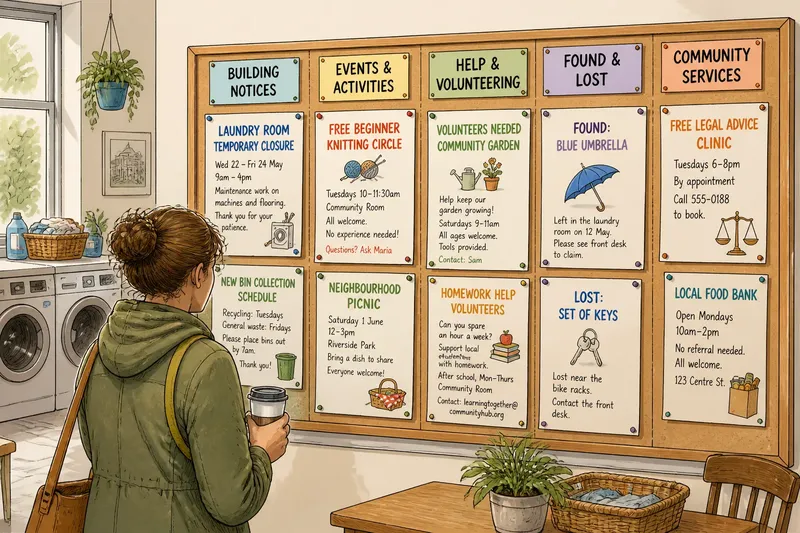
Where should you look first on a crowded shared noticeboard? A readable shared noticeboard answers that question before you scan every sheet: messages are grouped by purpose, and each notice starts with a heading that names its subject. That matters in a lobby, library, laundry room, or community center where people may pause only briefly.
The aim is not to make every board look alike. Match the arrangement to the people who use the space, then make each message easy to identify. Start with what readers most often need to find.
Choose for readers
A board works best when its groups reflect the questions neighbors bring to it. Someone looking for a lost mitten should not have to sort through class announcements first, and a resident checking a building notice should not mistake it for a personal invitation.
- Building lobby: Keep building notices separate from community invitations and personal messages. If a notice concerns shared services or the property, place it under a building label; otherwise, use the group that fits its purpose.
- Library or community center: Group classes, volunteer opportunities, and local services by what readers can do or find. If several notices offer the same kind of opportunity, place them together; if their purposes differ, use distinct labels.
- School or family hub: Mark whether a notice is for caregivers, children, or the wider neighborhood. If its audience is clear, use that label to guide placement; if it serves several audiences, group it by its main purpose and state the audience in the heading.
- Small, low-traffic board: Prefer a few broad categories to many narrow ones. If a category has only an occasional notice, combine it with a related group; if readers need to distinguish its contents, keep it separate and label it plainly.
Say a shared laundry room has a board crowded with class flyers, a note about a found key, and a message about a temporary room closure. If the board has “Activities,” “Found and Lost,” and “Building Notices” sections, a resident can start in the relevant area instead of reading all three papers.
Group by purpose
A category should describe what a reader can do with the information, not merely who posted it. “Local group” says something about the sender; “Volunteer opportunities” tells readers what kind of message to expect.
Use a small set of plain labels. Depending on the setting, useful groups might include:
- Building notices: Check whether a message concerns shared spaces or services; if it does, place it here, and if not, choose a purpose-based category.
- Events and activities: Check whether people are invited to attend a gathering, class, or open session; if so, use this group, and if the notice asks for help instead, use volunteering.
- Help and volunteering: Check whether the notice requests time, skills, or practical assistance; if it does, place it here, and if it mainly announces an event, use events and activities.
- Found and lost: Check whether the message reports a missing or recovered item; if so, place it here, and if it concerns shared property or services, use building notices.
- Community services: Check whether the notice points readers to a local resource; if it does, use this group, and if it invites participation in a specific activity, use events or volunteering.
These are starting points, not a required set. If one group regularly contains unrelated messages, split it; if a section stays nearly empty, combine it with a related category. Keep the label that helps someone predict what is posted there.
Place category labels where they stay visible above or beside the notices. A printed strip or clearly written card can make the division legible without adding more text to every page.
Write direct headings
A notice heading is a short signpost, not a slogan. Use familiar words that name the subject so a reader can decide whether to continue.
“Community news” is too broad to distinguish one message from another. “Free beginner knitting circle” tells readers what is offered; “Found: blue umbrella” identifies the item and its status. Put the most useful noun or action first, rather than using an unexplained group name or decorative phrase as the only heading.
Under the heading, give readers the details they need to judge the notice: who it is for, what is happening or requested, where it applies, and how to follow up. An event notice might name the activity, audience, venue, and contact method. A building notice might name the affected area and the change without burying that information in a long opening.
Make the heading visually distinct with bold type, larger lettering, or a simple underline. If people often read the board from a distance, check the wording and lettering from where they naturally stop; revise anything that is hard to distinguish there.
Fit the shared space
The board’s location affects how much detail readers can take in. In a narrow passage, people may have little room to pause, so clear labels and short headings matter more than elaborate design. In a lounge where readers can sit nearby, longer notices may be easier to read, but useful details still belong near the top.
Leave visible space around category labels so they do not merge into the papers beneath them. Use a consistent arrangement, such as a row or column, so readers learn where to look. For people with different reading needs, plain language and legible contrast are more useful than color alone.
Color can support grouping, but it should not carry the meaning by itself. Pair each color choice with a written label so the categories remain clear on faded paper or a black-and-white copy.
When should layout change?
What if one category fills the board?
Check whether the notices share a purpose or were grouped only because they came from the same organization. If they serve distinct reader needs, split the section with clear labels; if they are genuinely one topic, keep them together and follow the board’s usual practice for removing older or less relevant notices.
What if a notice fits two sections?
Choose the section that best matches why a reader is likely to seek the notice. A neighborhood cleanup invitation usually belongs with activities or volunteering, while a shared entrance closure belongs with building notices, even if both mention the same location.
Should notices share a format?
A consistent order helps readers compare messages: heading first, followed by essential details and a contact route. Tailor the details to the purpose; a lost-item note needs an item description, while an event notice needs information about the activity and where to learn more.
What if readers pass quickly?
Make group labels and headings carry more information, and move the most useful detail toward the top of each notice. Readers should be able to identify the paper’s subject before stopping to read the full text.
Arrange the board
For a board that needs a fresh layout, start with the messages people see rather than with decoration. Sort current notices by the action or information they offer, then choose labels that describe each group in everyday language.
- Gather the notices currently on the board and identify the purpose of each one.
- Group notices that answer the same kind of reader need; if one group contains distinct purposes, separate them, and if a group is too narrow to be useful, combine it with a related one.
- Write short category labels. If a label does not help a reader predict the contents, replace it with a clearer phrase.
- Place each paper under one main label and give it a heading that states its subject or action. If it could fit two groups, choose the one that matches its main purpose and mention any secondary detail in the notice.
- Stand where a reader would normally approach. If labels and headings are difficult to distinguish, reposition them or make the lettering clearer.
- Ask a neighbor unfamiliar with the arrangement to locate a particular kind of notice. If they hesitate or look in the wrong place, revise the label or placement; if they find it readily, keep the arrangement.
Imagine a neighborhood center with three notices about activities, two about local services, and one request for help carrying donated books. The organizer sorts the notices by purpose, places the activity notices under “Events and activities,” the service notices under “Community services,” and the request under “Help and volunteering.” The organizer then gives each notice a direct heading and asks a neighbor to locate a class; if the neighbor goes straight to the activity section, that label is working for this task, while hesitation would point to a need for clearer wording or placement.
Keep the layout flexible. If a new kind of message appears regularly, decide whether it belongs in an existing group or needs a distinct label; if it is an unusual one-off, place it under the closest purpose-based category rather than creating a section that may confuse readers later.
Keep headings useful
A board’s organization is only as clear as its least informative headings. Before posting, ask whether a stranger can tell what the paper concerns; if not, revise the heading. Then check that the category matches the reader’s likely purpose; if it does not, move the notice to a better-fitting group.
On a readable shared noticeboard, purpose-based groups narrow the search and direct headings confirm the right page. Keep labels plain, place notices consistently, and let the questions neighbors ask shape the categories as the board changes.