The Small Jobs That Make an Event Easier to Join
Small event jobs let neighbors contribute in a defined way, with clear duties and stopping points, while leaving room to attend without volunteering.
What can you offer a neighbor who wants to help at an event but cannot take on an open-ended role? Small event jobs give them a defined way to contribute, with a clear action and stopping point. They can also choose to attend without volunteering.
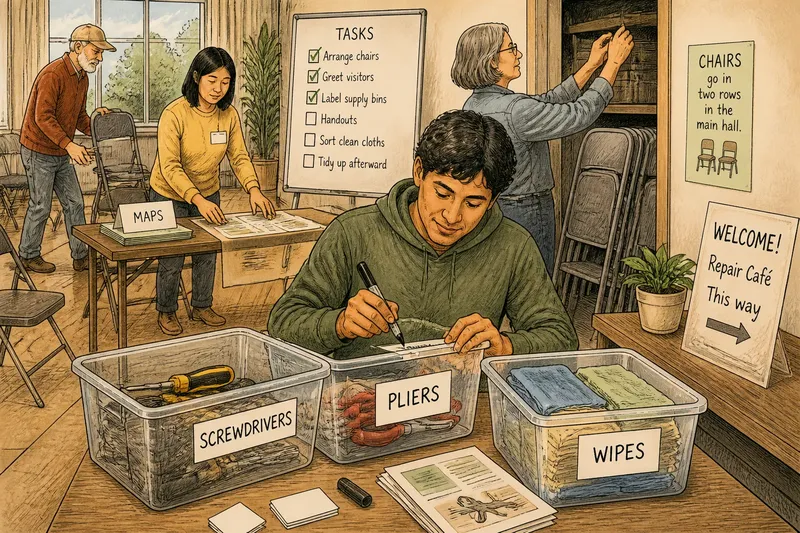
Imagine a neighborhood association preparing an afternoon repair café in a shared hall. The organizers need to arrange the room, direct visitors, keep the supply table orderly, and tidy afterward, but several neighbors cannot commit to a planning group or the full event.
The answer is to separate the work into optional tasks and explain each one plainly. A neighbor can then choose a job that fits their availability—or simply enjoy the gathering.
Map the Work
Before inviting anyone, list what has to happen from arrival through cleanup. Use actions such as carrying folding chairs from the storage closet, placing name tags beside the entrance, or returning unused tools to labeled bins.
Then distinguish necessary work from extras. The hall needs to be ready, and visitors need directions; flowers on the welcome table may be pleasant, but the event can proceed without them.
This distinction keeps invitations honest. If every task sounds essential, a small request can feel like an unspoken demand to take responsibility for the whole gathering.
For the repair café, the association marks a few jobs as needed and treats other ideas as optional. No one is expected to create a display, recruit friends, or stay for every part of the event.
Define Each Job
A useful description answers four questions: What will I do? Where and when? What materials are provided? Who can answer a question? It should also say how the task ends.
Instead of writing “help with setup,” the organizers write: “Place the folding chairs in two rows in the main hall before doors open; chairs are in the storage closet, and Maya can show you the room.” That gives a volunteer an action without making them responsible for the entire setup.
Another description might read: “Point arriving visitors toward the repair tables during the opening period; a printed room map will be at the entrance.” The greeter is not being asked to repair items, answer every question, or stay through cleanup.
Specific wording removes guesswork; it does not require a rigid script.
Offer Real Choice
Present jobs as separate options, not a package. A neighbor can choose one task, ask for more information, or decline without explaining why. Avoid implying that someone who claims a job must also recruit others or take on whatever remains.
Offer a quiet way to respond as well as a public sign-up sheet. For example, neighbors could write their names beside tasks at the association’s usual meeting place or contact the organizer directly.
Imagine Luis can arrive shortly before the repair café starts. The organizers have set out labels and a marker beside the supply bins, and the sign-up note asks for someone to label them before visitors arrive. Luis chooses that job, labels the bins, and leaves for another commitment; the finished labels show the task is complete, and no one expects him to remain.
The organizers can plan around his contribution without treating it as a promise to volunteer again. Attendance without a task remains a welcome choice.
Match Different Comforts
Some neighbors enjoy greeting unfamiliar visitors; others prefer practical work with little conversation. A mix of tasks lets people contribute in different ways without asking them to explain personal circumstances.
The repair café list might include sorting clean cloths, setting out handouts, welcoming visitors, and moving materials. Each job should have a clear purpose and end, but organizers should not assume any task suits everyone.
Carrying chairs may not suit someone who avoids lifting, while greeting people may feel uncomfortable to someone who prefers quiet work. Make it easy to request a different task, and do not treat that request as a test of commitment.
For work involving equipment or safety concerns, state the limits of the role and avoid assigning specialist tasks to unqualified volunteers. Consult the relevant instructions or a qualified person when needed.
Plan for Unclaimed Jobs
Keep a simple list showing each task, when it is needed, whether someone has chosen it, and who can answer questions. An empty name field is a planning signal, not an obligation for whoever happens to see it.
Decide in advance what happens if a job remains open. If handouts are essential, an organizer can set them out; if a decoration has no volunteer, omit it. If several people choose the same task, divide it only after confirming who will bring the materials and where the finished work belongs.
A paper sheet or shared document can track the details. The important part is making clear what is covered and what still needs an owner.
- Check whether the entrance needs a greeter. If visitors need directions and someone chooses the task, give them the map and a contact person; if no one does, post clear signs or have an organizer cover the entrance.
- Check whether chairs must be arranged before opening. If the job is claimed by someone able to move them, confirm the room layout and destination; if not, ask an organizer to arrange seating or simplify the layout.
- Check whether the supply bins have labels and markers. If both are ready and a volunteer claims the job, leave them together by the bins; if either is missing, provide the material or assign an organizer to prepare the bins.
- Check whether handouts are needed at the entrance. If they are essential and someone claims the task, set out the handouts and name the table; if no one claims it, have an organizer do it or tell visitors where to find the information.
- Check whether a proposed decoration is necessary. If the event works without it and nobody claims it, leave it out; if the organizers still want it, choose someone who has freely agreed to do it.
- Check whether a task calls for specialist judgment. If it does, refer it to a qualified person or remove it from the volunteer list; if it does not, describe the ordinary limits and provide the needed materials.
Support Volunteers
On the day, make task boundaries visible. A note by the storage closet can show where chairs belong, while the supply table can hold labels, markers, and an example of a completed bin. The greeter should know which organizer to ask about questions outside the role.
Check in without hovering. “Do you have what you need?” can uncover a missing-material problem, and “That’s all for this task” makes the stopping point clear. If someone wants to continue, they can offer; the organizers should not assume it.
If a visitor arrives without signing up, an organizer can mention an available, self-contained task. Make clear that helping is optional and that they are just as welcome to enjoy the event without taking on a job.
Questions About Event Jobs?
How small should an event task be?
Keep it small enough that the action, location, and stopping point are clear before someone agrees. If it combines unrelated duties or needs a long explanation, divide it into separate choices.
Should every task have a time window?
Give a time window when the work must happen before or during a particular part of the event. For flexible jobs, name the deadline or moment they are needed rather than implying the volunteer must stay for the whole gathering.
What if nobody chooses an important job?
Decide beforehand who will handle it or how the event will change if it remains uncovered. If it requires qualified expertise, do not pass it to an unprepared volunteer just to fill a slot.
How can someone withdraw after signing up?
Make it easy to tell the organizer when plans change, and keep the contact route clear. The organizer can update the list, take over the task, or adjust the event without treating changed availability as a personal failure.
Improve the Next Invitation
After the repair café, thank neighbors for the specific work they chose: the chairs were ready, visitors found the tables, or the supplies were easy to sort. Specific thanks recognize contributions without ranking people by how much they did.
Notice where descriptions caused confusion. If someone could not find the hall entrance, name the door next time; if labels were missing, specify who will set them out. These are adjustments to the plan, not judgments about the volunteers.
For a neighborhood event, small event jobs make participation easier to understand: choose one task, know what it asks, and know when it ends. Keep the invitation open to neighbors who would rather come as guests; that choice is part of making the gathering welcoming.